
Strange Sounds Led a Composer to a Long Career
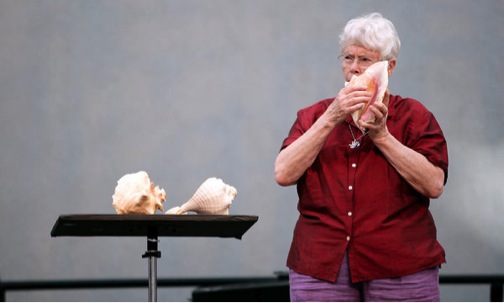
Pauline Oliveros in June, performing with the Deep Listening Band at the Bang on a Can Marathon.
By STEVE SMITH
Published: August 10, 2012
“MOST people don’t remember Wilma Deering,” the composer Pauline Oliveros said, recalling a formative influence from her childhood in Houston in the 1930s. Intrigued by sound from an early age, Ms. Oliveros had few role models to follow. Inspiration would come from a more unconventional source.
“Wilma Deering was Buck Rogers’s co-pilot,” Ms. Oliveros said of the recurring character in “Buck Rogers,” a science-fiction saga serialized by CBS Radio. “She was not only a woman in a co-pilot situation, but she was a lieutenant and then a colonel,” Ms. Oliveros said. “This was a very advanced idea for 1932.”
That Ms. Oliveros might find common cause with a courageous, assertive female leader, thriving in a futuristic milieu of instantaneous long-distance travel and telepathic communication, could only strike longtime followers of her work as prescient. Like her fictional forebear Ms. Oliveros has become a trailblazer.
 Her
path was not always smooth. “Why have there been no ‘great’ women
composers?” Ms. Oliveros inquired at the start of a famous article she
wrote for The New York Times in 1970. Her essay enumerated some of the
causes that had prevented female composers from achieving the success
and renown afforded to their male counterparts, among them sex-based
prejudice and societal expectations.
Her
path was not always smooth. “Why have there been no ‘great’ women
composers?” Ms. Oliveros inquired at the start of a famous article she
wrote for The New York Times in 1970. Her essay enumerated some of the
causes that had prevented female composers from achieving the success
and renown afforded to their male counterparts, among them sex-based
prejudice and societal expectations. Now, in a world that recognizes female composers more readily, Ms. Oliveros has captured enough ears, shaped enough minds and accrued enough renown to warrant a claim of greatness, though she would probably be the last to assert it. This year she has traveled widely for events celebrating her 80th birthday, including a memorable career retrospective concert at the Issue Project Room and a mesmerizing set by her Deep Listening Band during the Bang on a Can Marathon, both in June.
More concerts loom. Invited to program a two-week series at the Stone, the vital East Village musical laboratory operated by the composer John Zorn, Ms. Oliveros claimed just one evening for herself: On Aug. 21 she will collaborate with the percussionist Susie Ibarra and the pianist Thollem McDonas.
The rest of the series, which begins on Friday, will showcase colleagues, associates and protégés who have been involved with her Deep Listening Institute and its record label. Then, on Sept. 7, Ms. Oliveros will perform at the New Museum in SoHo with Doug Van Nort, an electronic musician with whom she works regularly.
Still, she eludes induction into the pantheon. In place of scores suited for assimilation into the Western classical canon, Ms. Oliveros offers “Sonic Meditations,” a 1971 collection of text-based contemplations, meant to facilitate communal music making. Deep listening, a discipline she developed during the 1990s, bypasses conventional music theory in favor of expanding consciousness through cultivating a keener ear. The Deep Listening Band, a long-running collaboration with the trombonist Stuart Dempster and others, pursues slow, ritualistic improvisation in unusually sonorous acoustics.
 “I’m
not dismissive of classical music and the Western canon,” Ms. Oliveros
said during a wide-ranging interview at the office of her foundation in
Kingston, N.Y., where she lives with her longtime partner, Ione, a
writer and performance artist. “It’s simply that I can’t be bound by
it. I’ve been jumping out of categories all my life.” She laughed, a
hearty sound that liberally punctuated a generous, easygoing
conversation.
“I’m
not dismissive of classical music and the Western canon,” Ms. Oliveros
said during a wide-ranging interview at the office of her foundation in
Kingston, N.Y., where she lives with her longtime partner, Ione, a
writer and performance artist. “It’s simply that I can’t be bound by
it. I’ve been jumping out of categories all my life.” She laughed, a
hearty sound that liberally punctuated a generous, easygoing
conversation. Born in Houston on May 30, 1932, Ms. Oliveros described a childhood fixation on the strange special effects she heard in “The Lone Ranger,” “The Creaking Door,” “The Shadow” and other radio dramas. “I was paying attention to that,” she said, “and I was paying attention to my grandfather’s crystal radio, where he was trying to tune in the programs and would get all this static.”
An avid accordionist from the age of 9, she took up the tuba and French horn to play in school bands and orchestras. While at the University of Houston, she studied with Willard A. Palmer, a revered accordionist and teacher. Eventually growing restless, Ms. Oliveros decided to strike out in search of a compositional mentor. “I was 20, I had $300, and I had an accordion,” she said, chuckling.
Drawn to California partly by Bach festivals in Carmel and Monterey, she settled in San Francisco, where she heard cutting-edge electronic works by Stockhausen, Berio and Pousseur on the Berkeley radio station KPFA-FM. When she received a tape recorder for her 21st birthday, she began to fashion her own pieces.
After completing a B.A. in music at San Francisco State College, Ms. Oliveros studied privately with Robert Erickson, an influential composer and the KPFA music director. She taught lessons and hustled gigs to make ends meet. A 1957 film-scoring engagement with the composer Terry Riley and Loren Rush, a bassist and koto player, introduced Ms. Oliveros to free improvisation. Invigorated by the experience, the trio experimented further and recorded the results.
“We developed a method, which was, don’t talk about it, sit down and play, listen back, then discuss it,” Ms. Oliveros said. “It was really getting into it through the listening process, and I’ve used that method for many, many years. We discovered that if we tried to impose rules or structure of some kind on our playing, it would fall flat. It was much better to converse openly.”
In 1961 Ms. Oliveros and two like-minded composers, Ramon Sender and Morton Subotnick, established the San Francisco Tape Music Center. A scrappy hub of creativity and technological advance whose effect is still being assessed, the center flourished until 1966, when its founders dispersed and Mills College absorbed its assets. Hired by Erickson in 1967 to teach at the University of California, San Diego, Ms. Oliveros remained there until 1981; she has since kept a toe in academia while pursuing a freelance career.
“Reverberations: Tape and Electronic Music, 1961-1970,” a new 12-CD box issued by Important Records, provides an overview of the rigorous works she created during the center’s heyday. Many still sound startlingly current. But from 1971, when a period of intense introspection provoked by the Vietnam War resulted in “Sonic Meditations,” Ms. Oliveros has moved decisively into ritualistic improvisation and communal experiences that can involve nonspecialist participants.
Lately much of her effort has involved impressive technological advances supported by her foundation. The Deep Listening Band uses special software to create uncanny simulations of resonant acoustics in its concerts.
Using telematics Ms. Oliveros performs in real time with musicians in other cities and countries. Adaptive Use Musical Instruments, an interactive computer program developed with her foundation’s support, enables individuals with severe physical impairments to participate in musical improvisation. Even Wilma Deering might be amazed.
Ms. Oliveros is aware of the tendency among some critics and listeners to dismiss her latter-day direction as a mystical anachronism. “If you say ‘deep listening,’ that brings up New Age and crystals and whatnot,” she said. “I regret that, but I don’t regret it. It is a meme, and it’s making its way in the world.”
But about the metaphysical aspects of her work, she is firm: “If it has a spiritual component, I’m very glad. It’s because we’re not listening to one another that things are in a mess.”